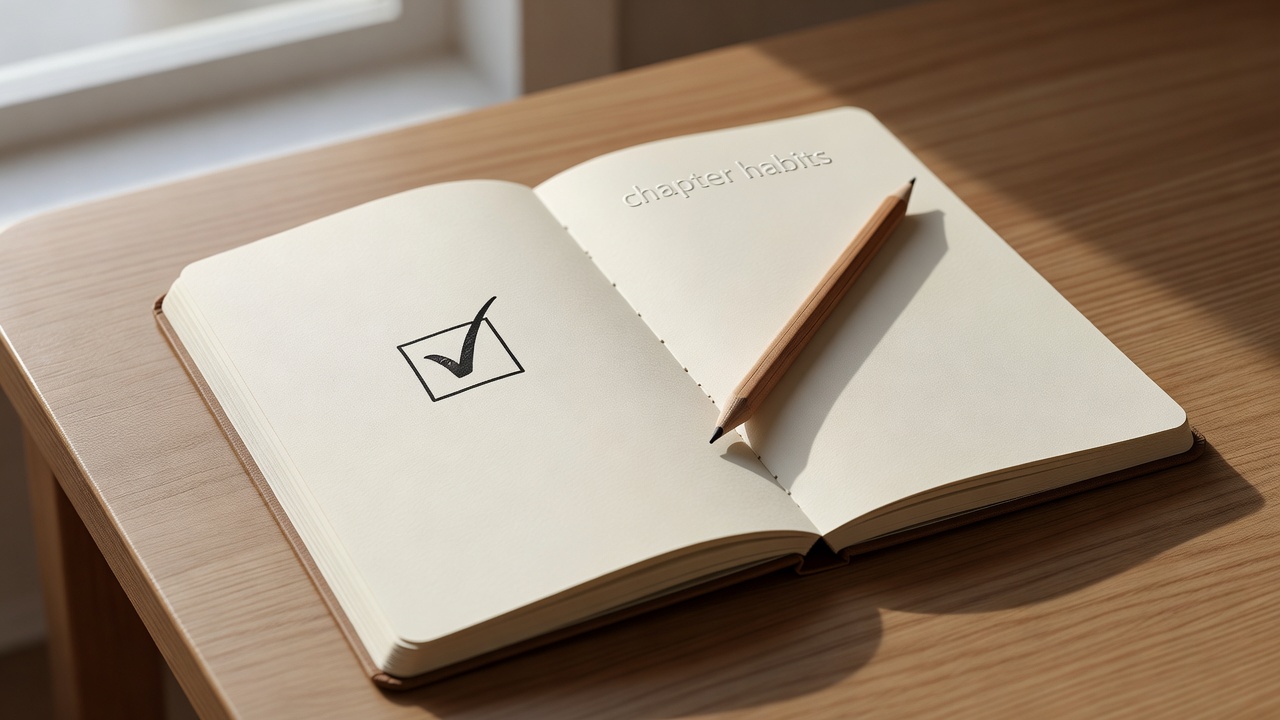
Most habit advice focuses on the destination — thirty days, an unbroken streak, a transformed routine. These notes focus on the start: lowering the effort of beginning so the behaviour can happen even when motivation is thin.
How long habits actually take
The popular figure of 21 days has little scientific basis. A 2010 study led by Phillippa Lally at University College London followed 96 volunteers who each chose a daily behaviour, such as drinking water with lunch or running before dinner. On average it took 66 days for the behaviour to reach its peak automaticity, but individual results ranged from 18 to 254 days.
Encouragingly, the same study found that missing a single opportunity did not materially affect the process. A missed day is data, not failure.
Context does much of the work
Wendy Wood, a psychologist at the University of Southern California, argues in Good Habits, Bad Habits (2019) that habits are driven largely by context: the place, the time, the action that came just before. In a diary study with Jeffrey Quinn and Deborah Kashy, she found that around 43 per cent of everyday actions were performed while people were thinking about something else.
Willpower is a poor foundation. A predictable cue is a better one.
Peter Gollwitzer's research on implementation intentions supports this. Plans phrased as "When situation X arises, I will do Y" consistently outperform vague goals; a 2006 meta-analysis by Gollwitzer and Paschal Sheeran found a medium-to-large effect across 94 studies.
Popular books translate these ideas into everyday tools. BJ Fogg's Tiny Habits (2019) suggests shrinking a behaviour until it is almost too small to skip. James Clear's Atomic Habits (2018) popularised "habit stacking", attaching a new behaviour to an existing one. Charles Duhigg's The Power of Habit (2012) framed habits as a loop of cue, routine and reward.

Experiments to try
- Write one implementation intention. Use the template "After I [existing action], I will [tiny new action]." For example: "After I pour my first coffee, I will open tomorrow's notes file."
- Shrink the start. Reduce the behaviour to under two minutes. For the first fortnight, the goal is showing up, not performing well.
- Remove one step of friction. Lay out running shoes, leave the book on the pillow, keep the water bottle on the desk. Wood describes this as adjusting friction in your environment.
- Track the beginning. Tick a box when you start. Anything beyond the tiny version is a bonus, not a requirement.
- Plan for the missed day. Decide in advance what a minimum version looks like on a bad day, so the routine bends rather than breaks.
Comparing habit techniques
| Technique | What it changes | Strength of evidence |
|---|---|---|
| Implementation intentions | Links behaviour to a specific cue | Strong: many controlled studies and meta-analyses |
| Tiny starts | Lowers the effort to begin | Moderate: plausible mechanism, fewer direct trials |
| Habit stacking | Uses an existing routine as the cue | Moderate: a practical form of implementation intentions |
| Environment design | Adds or removes friction | Moderate to strong for some behaviours, such as eating |
| Streak tracking | Adds visible feedback | Mixed: motivating for some, discouraging after breaks |
What to expect
Early weeks often feel deliberate and slightly awkward. That is normal; automaticity, if it arrives, does so gradually. If a habit still feels effortful after two months, consider whether the cue is stable enough, or whether the behaviour is one you genuinely want rather than one you feel you should want.
What this evidence cannot establish is how long your particular habit will take, or whether automaticity is the right goal for every behaviour. The studies describe averages across groups; your week is a sample of one, which is exactly why small experiments are worth running.
Sources mentioned
- Lally, P. et al. (2010). How are habits formed. European Journal of Social Psychology.
- Wood, W. (2019). Good Habits, Bad Habits. Farrar, Straus and Giroux.
- Wood, W., Quinn, J.M. & Kashy, D.A. (2002). Habits in everyday life. Journal of Personality and Social Psychology.
- Gollwitzer, P.M. & Sheeran, P. (2006). Implementation intentions and goal achievement. Advances in Experimental Social Psychology.
- Fogg, B.J. (2019). Tiny Habits. Houghton Mifflin Harcourt.
- Clear, J. (2018). Atomic Habits. Avery.
- Duhigg, C. (2012). The Power of Habit. Random House.